There’s a particular kind of paperwork that sits on the kitchen counter for weeks. A doctor hands you a lab slip, says “get this done in the next month or so,” and you fully intend to. Then the slip migrates to a drawer. Then to a pile. Then you’re back at your next appointment explaining that you didn’t get around to it.
Most people file this under procrastination. For a large number of us, it isn’t. It’s a nervous system doing exactly what it was built to do, in an environment that happens to be very good at setting it off.
Needle fear is more common than almost anyone admits
The CDC has a dedicated page on needle phobia, which tells you something about how routine the problem is. The agency’s framing is blunt: fear of needles can become severe enough to “get in the way of important medical care.”
The numbers back that up. Harvard Health reports that fear of needles affects up to 25% of adults, and that an estimated 16% of Americans skip vaccinations because of it. A 2022 survey published in PLOS ONE found higher numbers still — 63% of respondents reported some degree of needle phobia, and 52% said they had avoided a blood draw because of it. That survey was an opt-in online panel funded by a medical device manufacturer, so it likely over-represents people who already had feelings about the subject. But even the conservative estimate means that in any room of twelve people, three are quietly dreading their next lab slip.
What almost none of them do is say so. Needle fear carries a whiff of childishness that keeps adults from mentioning it — which means the person drawing your blood often has no idea, and you end up managing it alone.
It isn’t squeamishness. It’s a reflex.
The thing that makes needle fear different from most other anxieties is that it has a physical mechanism attached.
For many people, the sight of a needle or blood triggers what’s called a vasovagal response — a reflex that causes a sudden drop in blood pressure and heart rate. That’s the lightheadedness, the cold sweat, the ringing ears, the occasional faint. It isn’t a failure of willpower, and telling yourself to relax doesn’t reliably stop it, because the reflex arc doesn’t route through the part of your brain that makes decisions.
Clinicians take it seriously enough to build procedure around it. The CDC’s vaccine administration guidance instructs providers to “have the patient seated or lying down,” to watch for “weakness, dizziness, pallor,” and to “strongly consider observing patients (seated or lying down) for 15 minutes.” That guidance is written for vaccination rather than venipuncture, but it’s the same reflex, and it tells you the medical establishment regards fainting as a foreseeable event to be designed around — not a personal failing.
Which matters, because it changes what “getting over it” actually requires. You can’t reason your way out of a reflex. You can, however, change the conditions that feed it.
The waiting room does a lot of the work
Here’s the part that gets overlooked in nearly every article on this subject.
Standard advice for needle fear is almost entirely patient-side: breathe deeply, look away, bring a friend, ask for a numbing spray. All of it is reasonable — the CDC’s own list includes numbing cream, distraction, deep breathing, and rehearsing the procedure in advance. And all of it is aimed at the ninety seconds when the needle is actually in your arm.
But for most people, ninety seconds isn’t the hard part. The hard part is the ninety minutes before it.
Think about the actual sequence of a routine lab visit. You drive there thinking about it. You look for parking thinking about it. You check in, take a number, and sit in a room where the smell is unmistakably clinical, where you can see the draw stations, where other patients walk past you holding gauze to their elbows. Every few minutes a name gets called and it isn’t yours. Your body has now had an hour of uninterrupted rehearsal time, and anxiety responses tend to compound during exactly that kind of unstructured waiting.
By the time you sit down in the chair, a good deal of the physiological escalation has already happened. The phlebotomist — usually competent, often kind, and almost always behind schedule — has about two minutes to work with what the waiting room handed them.
Buried in the CDC’s list of accommodations is one that nobody talks about, and it isn’t a breathing technique. It’s environmental: “using private spaces for greater comfort during treatment.” That is a recommendation about the room. And it’s the one variable that, until fairly recently, patients had no way to change.
What changes when the draw happens at home
Mobile phlebotomy — a certified phlebotomist coming to your home or office to collect the sample — has mostly been marketed as a convenience, useful if you’re busy or homebound. That’s true, and it undersells the more interesting part. For people with needle fear, the meaningful change isn’t the commute. It’s four specific things:
The anticipation window collapses. There’s no drive, no parking, no lobby. You’re doing something ordinary in your own kitchen, and then someone knocks. The rehearsal period a waiting room provides simply doesn’t exist.
The environmental cues are gone. No clinical smell, no other patients, no visible draw stations. For a reflex that’s partly cued by setting, removing the setting does real work — and it’s the “private space” the CDC recommends, taken to its logical end.
You can lie down. This is the underrated one. The CDC tells providers to seat or lay patients down precisely because it reduces fainting risk. Most outpatient labs have fixed draw chairs and a queue behind you, and they aren’t always set up to accommodate lying flat for a routine draw. Your own couch is.
The phlebotomist has one patient. Not twelve, with a waiting room filling up behind them. There’s time to explain what’s happening, to go at your pace, to pause. If you’ve ever felt rushed through something you were dreading, you’ll recognize why that matters.
None of this is a treatment for a genuine phobia. But it removes several of the things that reliably make it worse — which, for a lot of people, is the difference between getting the test done and letting the slip sit in a drawer for another six months.
What at-home draws don’t fix
It’s worth being straight about the limits, because a service that oversells itself isn’t much use to someone deciding whether to try it.
There is still a needle. Someone still has to find a vein, and if you’ve historically been a difficult draw, you may still be one at home. If you faint, you’ll faint on your own sofa instead of in a clinic chair — which is genuinely safer, but it’s still fainting.
Mobile phlebotomy is also a collection service, not a laboratory. The phlebotomist draws the sample and transports it to the lab your doctor specified; the testing and the results still come from that lab, on that lab’s timeline. You’ll generally need an order from your provider before anyone can draw anything.
And if your needle fear is severe enough that it’s kept you from medical care for years, a change of setting is a useful accommodation, not a substitute for treatment. The CDC’s own guidance points toward seeing “a doctor who is an expert in helping with fears,” and exposure-based therapy has a strong track record here.
How to find someone who does this
Coverage is the practical constraint. Mobile phlebotomy has expanded quickly, but availability still varies by metro area, and same-day appointments are easier to get in dense markets than rural ones.
Two ways to approach it. You can go directly to a national provider — Speedy Sticks, for instance, operates across 47 states and more than 50 metro hubs, handling everything from routine draws to pediatric and long-term-care collections. Or you can search a directory of certified mobile phlebotomists by location and compare who’s available in your area — GetDraw runs one — which is often the faster route if you’re not sure what’s near you.
Either way, book the window with a little slack in it. Rushing is the enemy of a calm draw, and that applies to the person drawing as much as to you.
How the process usually works
For anyone who’s never done it, the sequence is undramatic:
- You get an order. Your provider sends the lab requisition, same as they would for a walk-in visit.
- You book a window. Most services let you schedule online and pick a time block that suits you. Standard appointments typically run weekdays; if you need something same-day, it’s usually worth calling rather than booking online.
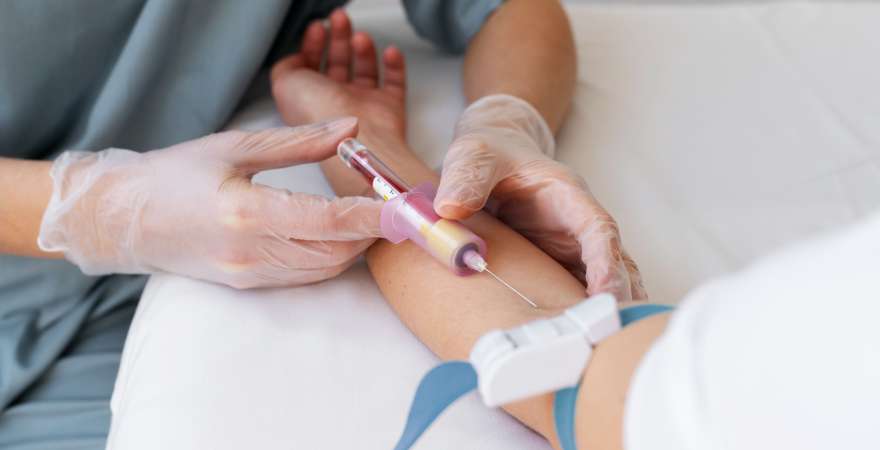
- A certified phlebotomist arrives. They’ll confirm your identity against the order, set up on a table or counter, and walk you through what’s happening before anything starts.
- The draw takes a few minutes. Then labeling, packing, and out.
- The sample goes to the lab. The phlebotomist transports it under the required handling conditions, and your results come back through your provider or the lab’s portal, exactly as they normally would.
The rules don’t relax because the setting is domestic. HIPAA privacy protections apply to a draw done in your living room the same way they apply to one done in a clinic, and the same standards for sterile technique and sharps handling carry over — the phlebotomist brings their own sharps container and takes it with them when they leave. Reputable providers use certified phlebotomists and can tell you so without hesitating.
What to ask before you book
If you’re going to try it, a few questions sort the serious operations from the rest:
- Are your phlebotomists certified, and through which body? A straight answer here is a good sign.
- Which labs do you deliver to? You want the one your doctor named, not a substitute.
- What happens if the first stick doesn’t work? Ask about their policy on difficult draws before you’re in the middle of one.
- Can I tell you in advance that I’m anxious or have fainted before? The answer should be an enthusiastic yes. A phlebotomist who knows in advance can position you lying down from the start and pace things differently.
That last one is worth doing regardless of where you get drawn. The PLOS ONE survey found people rated their providers’ helpfulness with needle fear at 4.9 out of 10 — but a striking share had never told a provider about it in the first place. It’s hard to accommodate something nobody mentions.
The slip in the drawer
Blood work is one of the few genuinely high-yield things in preventive medicine. As MedlinePlus puts it, medical tests “can help detect a condition, determine a diagnosis, plan treatment, check to see if treatment is working, or monitor the condition over time.” Thyroid problems, anemia, kidney and liver changes and a long list of other things show up in bloodwork well before they announce themselves in any other way. The CDC’s guidance on preventive care makes the same point in one line: routine preventive care “can help you stay well and catch problems early.”
The cost of skipping it isn’t the skipped appointment. It’s the years of not knowing.
If what’s standing between you and that lab slip is a room you don’t want to sit in, that’s a solvable problem — and a more common one than the silence around it suggests. The setting turned out to be the removable part.
Get the test. Just maybe get it somewhere you don’t dread.
This article is for general information and isn’t medical advice. Talk to your healthcare provider about your own testing needs, and about needle anxiety if it’s affecting your care.
Author bio
Daniel Buitrago is the founder of Speedy Sticks, a national mobile phlebotomy and specimen collection company serving patients, healthcare providers, senior living communities and clinical research organizations across 47 states, and of GetDraw, a nationwide marketplace connecting patients with certified mobile phlebotomists. To book an at-home draw, visit speedysticks.com or call 347-292-9570.
(Alternative non-founder byline: “The Speedy Sticks team provides certified mobile phlebotomy and specimen collection services nationwide.”)